
Historically, the UK has directed a relatively high share of its official development assistance to research and development in low- and middle-income countries, with the aim of informing policy and improving lives. As development budgets face deep cuts, funders and researchers are under growing pressure to show that this investment makes a difference. This raises a deceptively simple question: how do we know whether research is being used and that this use is improving lives?
The outcomes associated with research use vary, and some are easier to measure than others. The production and spread of new knowledge, for example, can be tracked through digital object identifiers or citations, and this is becoming simpler with open-science, new methods and AI. But whether research has been used in policy, beyond citations in policy documents, is more difficult to understand. Indeed, what helps or hinders policymakers’ use of evidence is itself the subject of a growing body of research. Yet practical, affordable approaches to monitoring and learning, as distinct from costly one-off evaluations, are discussed less, and what organisations learn often stays in-house.
This blog aims to open up some of that learning. It draws on practitioner experience and relevant literature shared in a virtual workshop in June 2026, convened by the GRTD Research Commissioning Centre (RCC), which is funded by the UK government’s Foreign, Commonwealth & Development Office (FCDO). At the workshop, research funders, researchers and monitoring, evaluation and learning (MEL) practitioners compared notes on common challenges and what works.
We explore three questions: what kind of change are we looking for? Why is it so hard to track? What systems can help? We comment on the importance of good monitoring data for effective evaluation and we end with some thoughts on what is next on the horizon.
1. Start with the change you are looking for
Research can influence policy in many ways, and the outcomes vary widely. A change in policy content, such as a new or redesigned policy, may be one of the most visible goals, but it is can also be more distant and uncertain. Being clear from the outset about the different kinds of change a project is aiming for, and using more standardised outcomes where feasible, makes it easier to measure progress.
To help anchor this, a conceptual framework developed under the RCC’s Evidence-Informed Policy Making (EIPM) research programme, groups outcomes of EIPM into four types (Figure 1): conceptual (shifting how policymakers think about and define a problem), attitudinal and behavioural (increasing openness to and engagement with evidence), procedural (building evidence into how decisions are made) and content (changes to policies, legislation and resource allocation).
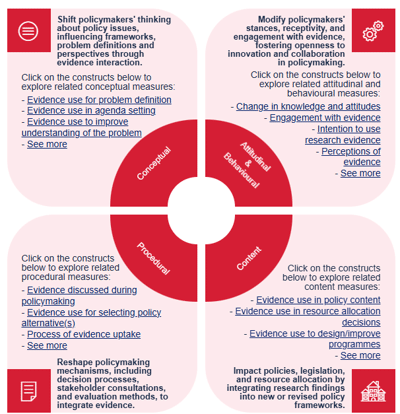
Meaningful understanding of research findings and uptake can happen well before, or instead of, observable policy influence. Earlier signals might include policymakers requesting evidence, researchers being invited onto advisory groups, research being referenced in policy discussions, shifts in the language used in debate, use of research by civil society organisations (often acting as intermediaries), or evidence shaping which issues reach the agenda.
It also helps to organise outcomes by how much control researchers have over them. Within their sphere of control, researchers can produce high-quality, relevant research, and quality can itself be assessed, for example using the Research Quality Plus (RQ+) framework developed by Canada’s International Development Research Centre (IDRC). Within their sphere of influence, they work to see evidence taken up by policymakers and practitioners. The ultimate aim (or impact), which can be broadly described as improved lives, sits in a wider sphere of interest, shaped by many actors. Framing research’s role as a contribution, rather than trying to attribute change to it, recognises that researchers are, more often than not, one influence among many. Other ways of conceptualising the research-to-policy pathway, such as the ‘pyramid’, ‘influencing’ and ‘results chain’ approaches reviewed in Sheila Siar’s paper on measuring research’s influence on policy, offer complementary lenses.
Outcomes also include increased receptivity and engagement with research (attitudinal and behavioural change in the EIPM framework). Alix Bonargent’s study of more than 500 development economics research projects from the International Growth Centre found that those developed with policymakers’ involvement were 17-20% more likely to lead to observed policy change.
A practical example is the Climate Adaptation and Resilience (CLARE) programme’s Co-Creation Labs, which is structured to bring together stakeholders, including marginalised communities, enabling collective learning and co-designed approaches to resilience to climate change. A recent blog considers the research to policy trajectory under CLARE and is based on a workshop from CLARE researchers. It identifies similar complexities in the research to policy pathways for the adaptation and resilience policy landscape, including non-linear routes, the important early signals of influence and navigating politics and actors.
2. Why influence is so hard to track
The path from research to policy is complex and rarely linear. Unlike interventions with more predictable outcomes, policy influence is a complex process: the desired result may not be clear at the outset, learning is iterative, there are many unknowns and feedback loops, and events are hard to foresee. Impact objectives and pathways evolve over time, so indicators may need regular updating too.
Influence is often indirect. Research may shape how a problem is framed rather than the final decision, travel through intermediaries, or inform decisions many years after a project has ended. Relationships are central: trust, credibility, access to decision-makers and informal influence often determine whether evidence is used. Yet these are precisely the things that traditional MEL systems struggle to capture. This creates a particular challenge for monitoring. Evidence of influence may be anecdotal or scattered across emails, meetings and conversations. Policymakers often want to own (and should own) their decisions, which makes attribution challenging, and occasionally contentious. And because pathways are unpredictable, it is hard to know in advance which information will be needed later, for instance, which meetings or points of engagement may be most critical for influencing research use. As a result, monitoring indicators will often be designed to capture signals that evidence has been shared, understood and engaged with – all precursors to eventual use in decision-making.
3. Building systems that capture what matters
So, what can funders and MEL practitioners do in practice? Several trade-offs and design choices stand out.
Harmonisation versus customisation. Standard progress and end-of-project reports make results comparable across a portfolio, but research outcomes vary widely and are hard to predict, so most funders develop customised templates for their grantees. Templates often need to accommodate non-linear pathways, different levels of ambition, and diverse themes, geographies and contexts. In the RCC’s reporting systems, grantees document their intended outcomes, achievements and supporting evidence; the RCC then records and assesses progress against those intentions.
More harmonisation of impact reporting across organisations with similar portfolios could enable more sector-wide learning. With the UK’s research reporting platform Researchfish closing, now is a good time to explore alternatives and consider ways to bring more unified approaches to the ways funders and researchers track outcomes.
Breadth versus depth. Not every element of an ideal MEL system will be achievable, so clear objectives should guide design choices. Self-reported information may be sufficient for internal learning, whereas reporting externally or understanding impact over the longer term requires corroborating evidence and more robust approaches. Funders may need to make difficult choices between tracking influence across their full portfolio and investing in deeper assessment of selected cases. In those deeper assessments, cases where research was not used can be as instructive as those where it shaped decisions.
Organising scattered evidence. Influence often flows through sporadic relationships with actors who change over time, so tracking these communications is important but time-consuming. As Chemonics has found from tracking the impact of the Cross-Border Conflict Evidence, Policy and Trends (XCEPT) programme, an information management system with a relational database frameworkcan bring structure, for example by tagging evidence by geography, stakeholder, theme or alignment with a project’s theory of change. Useful sources include emails, meeting notes, citations, screenshots, monitoring data, feedback from implementing partners, information about project context, and team reflections. Organised relationally allows tagging across evidence pieces to speak to each other and aggregate efficiently, allowing evidence to support coherent contribution stories and internal decision-making.
Tracking over the longer term. Impact often arises after a grant has closed. One option, which the RCC is considering, is to structure project cycles so that delivery happens within a fixed period but a window for follow-up remains open afterwards. Many large funders contractually require researchers to submit evidence of outcomes or impact after grants are closed. Either way, funders need to keep the reporting burden as light as possible and make sure the information is actually reviewed and used.
Incentives to report honestly. When reporting is tied to funding, grantees may feel pressure to present success rather than share partial progress or setbacks. Funders who make clear that they value candid reporting, including on what did not work, are more likely to receive data they can learn from.
4. From monitoring to evaluation
Good monitoring data lays the foundation for more robust evaluation. Two approaches the workshop explored are particularly well suited for understanding policy influence. Outcome mappingfocuses on changes in the behaviour, relationships and actions of the people and organisations a programme works with, and the strategies needed to support them in complex systems. This approach also prioritises contribution over attribution. Theory-based approaches begin with a practical theory of change for the programme or project; signals of change can then be marked along the pathways. This allows for feedback loops and recognises that a project’s influence tends to weaken further along the causal chain.
Investing in well-designed monitoring now makes it easier to show, later on, what research funding has achieved for society.
Looking ahead
Can AI help? Technology could reduce some of the burden. Natural language processing tools show promise for making sense of unstructured text such as emails, meeting notes, social media and policy documents, and even for gauging policymakers’ attitudes. AI can also track mentions of research in policy documents, a task that is onerous by hand. But these tools are less useful for informal material or content in local languages, and much research uptake (through local knowledge, informal networks and relationships) never appears in searchable sources at all.
Learning that shapes what we fund. Perhaps the biggest opportunity is to use what we learn to inform funding decisions. Organisations such as IDInsight are exploring how impact measurement frameworks can help assess a project’s potential for impact at the selection stage, for example by considering how invested policymakers and other stakeholders are, the capacity of partners, and the extent of co-production. Since we know co-creation is often a more effective way of ensuring research relevance and use, funders can build it into programme design, incentivise it, and encourage research teams to plan for engagement from the start. Less explored is how to co-create in practice.
From projects to portfolios. With fewer resources and more pressure to demonstrate value, the field needs to move beyond project-by-project assessments towards a more systematic understanding of the value of research. That will mean collaborating more and exploring new approaches so that we can look across funders and ask: how has research on topic X shaped outcomes and impact for this area? No single funder can answer these questions alone. The RCC wants to keep this conversation going beyond the workshop and to encourage cross-organisational learning. If your organisation is tackling the same challenges, please get in touch: email rcc@3ieimpact.org with Research Use in Policy in the subject line.
Acknowledgements
This article draws on a virtual workshop held by the GRTD Research Commissioning Centre (RCC) in June 2026. We are grateful to Alix Bonargent (IDInsight), Oliver Ellis (Chemonics), Kaia Ambrose (International Development Research Centre) and Sumetee Pahwa Gajjar (PlanAdapt Collaborative) for sharing their experience, and to all participants for their thoughtful contributions. Any errors are our own.f