
About EIPM
Evidence-Informed Policy-Making (EIPM) is one of the Research Commissioning Centre’s (RCC) flagship funding programmes. Through commissioned research grants, it explores how leaders in low- and middle-income countries (LMICs), particularly across Sub-Saharan Africa and South Asia, use evidence in policy-making for national economic growth. It also identifies approaches that can strengthen evidence-informed decision making across different political and institutional contexts.
What EIPM delivers
The EIPM is generating:
- rigorous research on how evidence informs economic policy-making in practice;
- greater understanding of what approaches strengthen evidence use, for whom and under what circumstances; and
- actionable lessons for governments, funders, researchers and evidence intermediaries through publications, events and knowledge-sharing activities.
So far, the programme has awarded 17 grants across two research streams:
- studies of evidence use in practice;
- interventions to influence the use of evidence.
Why evidence-informed policy-making matters
While the value of evidence-informed policy-making is widely recognised, there is still limited understanding of how evidence is used in practice, particularly in politically complex and resource-constrained settings. Despite decades of global investment in strengthening evidence use, barriers remain, including weak governance structures, limited political and institutional incentives, and fragmented evidence on what approaches are most effective.
The EIPM programme responds to these challenges by delivering practical, actionable insights for researchers, partners and policy-makers.
History
The EIPM programme was developed through three complementary phases:
Building a conceptual framework
A conceptual framework and measurement toolkit developed to assess evidence use in policy-making.
Examining evidence use
Awards granted to projects examining when, how and why evidence informs, or fails to inform, policy decisions.
Evaluating interventions
Awards granted to projects evaluating interventions designed to strengthen evidence-informed policy-making in practice.
Evidence-Informed Policy-Making: An interactive conceptual framework
Strengthen collaboration through partnerships, trust, knowledge-sharing, and sustained engagement.
Click on the constructs below to explore related measures of relationships & networks:
- Engagement between policymakers and researchers
- Performance of communities
of practice
- See more
Develop skills through training, mentorship, peer learning, and institutional adaptation.
Click on the constructs below to explore related measures of capabilities:
- Capacity to use research evidence
- EIPM Knowledge and Skills
- Organisational capacity
for EIPM
- See more
Shift norms, beliefs, leadership, and learning culture towards evidence use.
Click on the constructs
below to explore related measures of evidence culture:
- Demand for evidence
- Evidence culture
- Participatory decision making
- See more
Establish mechanisms, policies, and systems, and incentives to support evidence-informed policymaking
Click on the constructs
below to explore related measures of structures & processes:
- Access to evidence
- Administrative evidence-based practices
- Participatory decision making
- See more
Shift policymakers' thinking about policy issues, influencing frameworks, problem definitions and perspectives through evidence interaction.
Click on the constructs below to explore related conceptual measures:
- Evidence use for problem definition
- Evidence use in agenda setting
- Evidence use to improve understanding of the problem
- See more
Modify policymakers' stances, receptivity, and engagement with evidence, fostering openness to innovation and collaboration in policymaking.
Click on the constructs below to explore related attitudinal and behavioural measures:
- Change in knowledge and attitudes
- Engagement with evidence
- Intention to use
research evidence
- Perceptions of
evidence
- See more
Reshape policymaking mechanisms, including decision processes, stakeholder consultations, and evaluation methods, to integrate evidence.
Click on the constructs
below to explore related procedural measures:
- Evidence discussed during policymaking
- Evidence use for selecting policy alternative(s)
- Process of evidence uptake
- See more
Impact policies, legislation, and resource allocation by integrating research findings into new or revised policy frameworks.
Click on the constructs
below to explore related content measures:
- Evidence use in policy content
- Evidence use in resource allocation decisions
- Evidence use to design/improve programmes
- See more
| Red/outer ring: | EIPM outcomes | |
| Dashed/black rings: | Moderating factors and contextual influences (barriers and facilitators) |
|
| Blue/middle ring: | Pathways of change | |
| Inner circles: | Actor ecosystem | |
| Large overlapping circles: | Evidence user, evidence producer, evidence intermediary organisations | |
| Small circles: | Individuals nested within organisations | |
| Triangles: | External actors |
Projects
Examining evidence use in practice
Using qualitative and mixed-methods approaches, these projects explore how political and institutional contexts shape evidence uptake and influence policy decisions across labour markets, taxation, agriculture, migration and national development planning.
Lead Institution: African Institute for Development Policy (AFIDEP)
Partners: Ministry of Labour and Social Protection, Kenya | Ministry of Energy and Petroleum, Kenya
Examines how research evidence informs national economic policy-making in Kenya, focusing on labour and energy policy reforms. Using comparative qualitative case studies of two recent high-priority policy processes, the research analyses how political economy dynamics, institutional arrangements and sectoral characteristics shape evidence use. The study aims to generate insights into when and why evidence influences policy decisions and identify entry points for strengthening evidence-informed policy-making in Kenya and similar contexts.
Lead Institution: Centre for Economic Research in Pakistan (CERP)
Investigates how evidence is generated, interpreted and used across different types of tax reform in Pakistan, such as tariff reform, property taxation or digital tax administration. Using a comparative qualitative design, the research examines how various political and institutional factors shape evidence uptake in fiscal policy-making. This study seeks to provide actionable lessons on strengthening evidence use in politically sensitive revenue reforms in South Asia.
Lead Institution: International Maize and Wheat Improvement Centre (CIMMYT)
Partners: Indaba Agricultural Policy Research Institute
Compares evidence use in seed and grain trade policymaking in Zambia, two closely related domains with contrasting policy trajectories. Using a mixed-methods comparative design, the research examines how evidence characteristics, actor networks and political economy incentives shape policy uptake. The findings aim to generate insights into why similar evidence achieves different levels of influence across policy areas and offer lessons for strengthening evidence use in agricultural trade policymaking.
Lead Institution: Growth Teams
Examines whether and how Growth Diagnostics influence economic policymaking in Sub-Saharan Africa and South Asia. Using retrospective comparative case studies in Cote d'Ivoire, Ethiopia, Tanzania and Sri Lanka, the research traces pathways from diagnostic production to policy design and implementation. The study intends to identify conditions under which diagnostic evidence informs reform agendas, as well as instances of symbolic or selective use, generating lessons for governments, donors and researchers seeking to improve the policy impact of growth diagnostics.
Lead Institution: International Food Policy Research Institute (IFPRI)
Partners: Institute of Public Opinion and Research (IPOR) Malawi | Policy Studies Institute (PSI) Ethiopia
Explores how research evidence has informed flagship agricultural commercialisation initiatives in Ethiopia and Malawi. Using comparative qualitative analysis, the research assesses evidence use across policy design, implementation and adaptation stages. By comparing two similar reform agendas in distinct political contexts, the study seeks to generate lessons on how evidence can more effectively inform agricultural and economic transformation strategies in Africa.
Lead Institution: Mettalytics
Partners: National Development Planning Commission (NDPC), Ghana | National Planning Commission (NPC), Malawi
Investigates how research evidence is used in the formulation of National Development Plans in Ghana and Malawi. Using comparative qualitative methods, the research examines where evidence enters decision-making processes, which actors and relationships confer credibility, and how political economy dynamics shape evidence uptake. The study aims to provide actionable recommendations for strengthening evidence-informed national economic planning.
Lead Institution: PoliSync Centre for International Policy Engagement
Partners: African Migration and Development Policy Centre (AMADPOC) | International Institute of Migration and Development (IIMAD)
Examines how evidence on the economic value of international migration is used or sidelined in policy-making in Kenya, Kerala (India) and Sri Lanka. Using a mixed-methods comparative design, the research analyses evidence use across remittances, labour migration and diaspora engagement policies. The study seeks to generate insights into how migration evidence can be more effectively embedded in economic decision-making in politically sensitive policy areas.
Lead Institution: Tegemeo Institute of Agricultural Policy and Development, Egerton University
Partners: International Food Policy Research Institute (IFPRI)| Michigan State University
Explores how evidence has shaped agricultural policy reforms in Kenya, focusing on fertiliser subsidies and coffee marketing reforms. Using a comparative qualitative design, the research analyses how policy visibility, complexity and interest group dynamics influence evidence uptake. The findings aim to generate lessons for strengthening evidence use in agricultural and economic reforms in Sub-Saharan Africa.
Evaluating interventions
These projects evaluate whether approaches designed to strengthen evidence-informed policy-making (such as policy labs, leadership training, behavioural interventions, and AI-supported tools) improve the use of evidence in practice and can be scaled and institutionalised.
Lead Institution: Center for Evaluation and Development (C4ED)
Partners: Ethiopian Economic Association (EEA)
Evaluates an 18-month intervention to strengthen evidence use in Ethiopian trade policymaking during a major reform period linked to WTO accession and AfCFTA integration. Using a cluster randomised controlled trial across 60 directorates, it compares training-only approaches with researcher–policymaker co-production and mentoring. The study plans to measure changes in skills, attitudes, and observable evidence use, generating actionable lessons for Ethiopia and global EIPM practice.
Lead Institution: DevelopMetrics
Partners: United Nations University - Maastricht Economic and Social Research Institute on Innovation and Technology (UNU-MERIT) | University of Moratuwa | Ministry of Finance | Ministry of Digital Economy
Tests whether a generative-AI evidence platform improves research use in Sri Lanka’s economic policy-making. In a randomised controlled trial in the Ministries of Finance and Digital Economy, policy documents will be drafted with or without AI assistance. Planned outcomes include the quality, traceability, and timeliness of evidence use, offering the first causal evidence on AI-enabled evidence intermediation in live policy processes.
Lead Institution: Global Health Economics
Partners: Makerere University School of Public Health | Makerere University School of Economics | Mbarara University of Science and Technology | ACE Policy Research Institute | Forum for Women in Democracy (FOWODE)
Evaluates behavioural and institutional strategies to increase evidence use among senior policymakers in Uganda during a key reform window. A 2×2 factorial RCT will test evidence framing and messenger credibility across trade, fiscal, and energy sectors. The study aims to measure observable evidence use in policy documents and budgets, generating new causal evidence on behavioural mechanisms for strengthening EIPM in low-income settings.
Lead Institution: Innovations for Poverty Action (IPA)
Partners: University of Warwick | Stanford Graduate School of Business | Ministry of Education, Côte d'Ivoire | Ministry of Education, Ghana | Ministry of Education, Kenya | Central Bank of Nigeria; Nigerian Communications Commission | Ministry of Education, Rwanda | Ministry of Education and Sports, Uganda | Ministry of Gender, Labour and Social Development, Uganda | Early Childhood Development Agency, Colombia | Environment Agency, Peru | Market regulator, Peru | Department of Education, The Philippines
Multi-country study that evaluates whether Embedded Evidence Labs improve policymakers’ capacity, motivation, and practice of using evidence. Using an encouragement-based cluster RCT across 12 government agencies in Africa, Latin America, and Southeast Asia, the study examines changes in knowledge, skills and observable evidence use. Findings will provide some of the first causal evidence on the effectiveness and sustainability of embedded evidence models.
Lead Institution: International Center for Tropical Agriculture (CIAT)
Partners: Policy Studies Institute (PSI) Ethiopia | Tegemeo Institute of Agricultural Policy and Development, Egerton University
Evaluates Evidence-to-Policy Sprints as a tool to strengthen evidence use in policymaking on informal food-system enterprises in Kenya and Ethiopia. Using a mixed-methods, quasi-experimental design, it plans to assess changes in policymakers’ knowledge, attitudes, and intentions following participation. The research fills a key evidence gap on whether short, collaborative policy engagement models can improve evidence uptake in contested policy areas.
Lead Institution: International Food Policy Research Institute (IFPRI)
Partners: Policy Studies Institute (PSI) Ethiopia | African Leadership Excellence Academy (AFLEX)
Tests whether leadership-focused capacity building and evidence intermediation can improve evidence use among senior policymakers in Ethiopia. Embedded within national leadership programmes, an individual-level RCT will compare training alone with enhanced evidence-use support and on-demand synthesis. The evaluation measures changes in demand for, trust in, and observable use of evidence, generating lessons for institutionalising EIPM at senior levels.
Lead Institution: Laboratoire d’Economie Publique (LEP)
Partners: Directorate of Research and Strategic Studies (DRES), Ministry of Economy and Finance | Directorate General of Evaluation (DG, OCS), Ministry of Planning and Development, Benin
Uses mixed methods to examine whether Benin’s first embedded policy lab—the Directorate of Research and Strategic Studies—strengthens evidence use in economic policymaking. Combining quasi-experimental methods, an RCT, and in-depth qualitative analysis, it aims to assess impacts on policymakers’ skills, demand for evidence, and policy practices. The study offers rare causal evidence on policy labs in Francophone West Africa.
Lead Institution: RAND Europe
Partners: Center for Rapid Evidence Synthesis (ACRES)
Evaluates how ACRES, a long-standing Ugandan knowledge brokering institution, supports evidence use by convening stakeholders and prioritising policy-relevant research questions. Using theory-based mixed methods, it examines changes in access to evidence, trust, relationships, and observable policy influence. The evaluation seeks to generate transferable lessons for strengthening knowledge brokering in economic policymaking.
Lead Institution: South African Medical Research Council
Partners: Evidence-to-Decision Initiative
Evaluates how and at what cost the Evidence-to-Decision initiative embeds systematic evidence use in South Africa’s health and social policymaking. Using nested case studies, process tracing, and cost–consequence analysis, it examines institutional pathways from evidence to policy influence. The findings aim to provide actionable insights on designing sustainable evidence-to-decision systems in complex governance contexts.
EIPM outputs and learning
Explore EIPM publications, learning products, events and other outputs from across the programme.
Pathfinding paper: Outlining a research agenda for improving evidence use
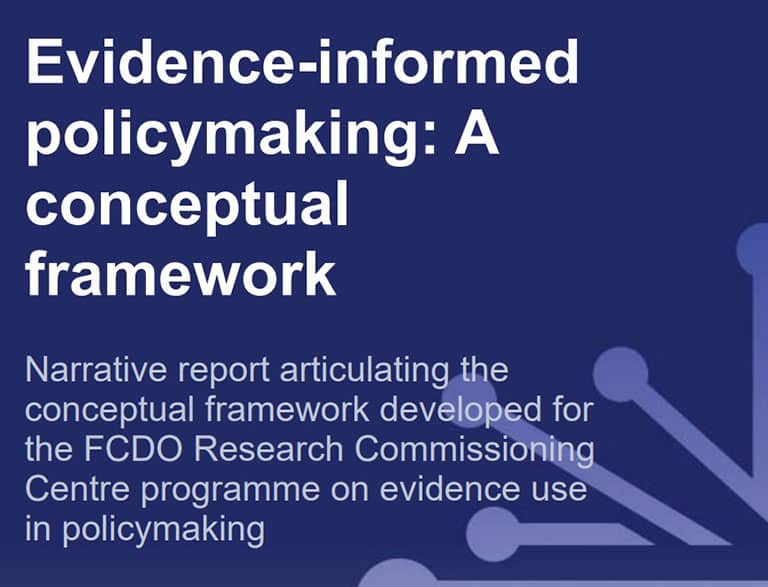
Conceptual framework: Mapping the pathways through which evidence influences policymaking processes
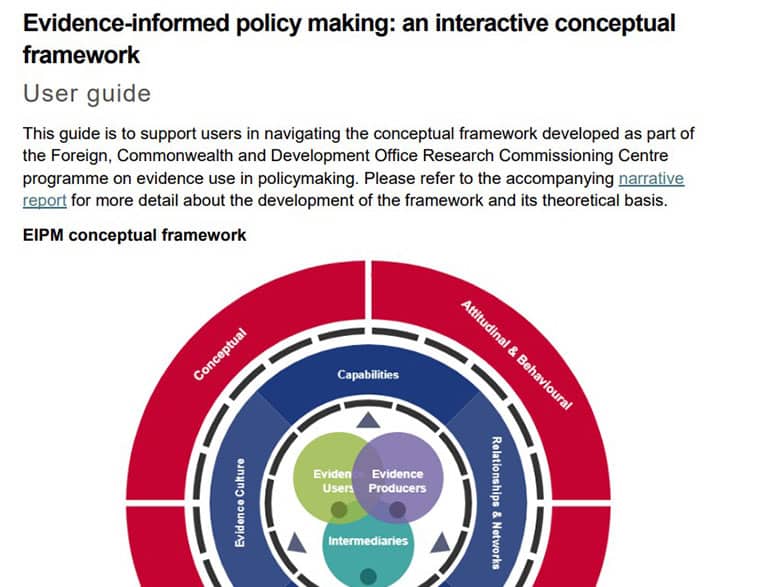
Inventory of measures: Cataloguing tools and indicators used to assess evidence use
Systematic review: What works to increase the use of evidence for policy decision-making
News

Embedding behavioural science in FCDO Innovation: A Technology and Innovation Unit portfolio review and toolkit
Technology and innovation are central to the Foreign, Commonwealth and Development Office’s (FCDO) approach to tackling complex development challenges.

Building a more equitable approach to research commissioning
Too often, research agendas and funding decisions are shaped in rooms far removed from the people closest to the development challenge.

Cross-sector lessons on supporting frontline workers in conflict
A significant body of research on service delivery in situations of fragility, conflict and violence has been built over the last 15 years but there has been limited synthesis of findings across research programmes and sectors.

From pilots to public value: Reflections on AI in food and agriculture from EvalFest and India AI Impact Summit
Artificial intelligence (AI) is increasingly shaping conversations about the future of agriculture. From predictive analytics to crop diagnostics, AI-enabled tools are opening up new possibilities for supporting farmers and strengthening food systems.

GRTD Research Commissioning Centre announces new awards on evidence use in economic policymaking in sub-Saharan Africa and South Asia
Evidence is central to effective economic policymaking, but how it is used in real-world decision-making

What does evidence-informed policymaking look like? A framework for conceptualising and measuring EIPM
The past two decades have seen a proliferation of activity supporting evidence-informed policymaking (EIPM) in low- and middle-income countries.