
How AI can help survivors in low-resource settings access justice
Justice systems in low-resource and conflict-affected settings are often stretched to breaking point. In Malawi, for example, fewer than 800 lawyers serve a population of 22 million, and legal aid caseloads run into the tens of thousands. Against this backdrop, a new learning brief on Access to Justice from the Frontier Tech Hub asks a timely question: can artificial intelligence (AI) technologies help close the gap, and can they do so safely?
Alongside interviews with practitioners, funders and academics working across gender-based violence (GBV) response, legal aid and international justice, the brief draws on case studies from three of the Frontier Tech Hub’s pilots. They are part of a wider Human Rights and Democracy cluster within the Hub’s portfolio, which has grown to 108 pilots over the last 10 years. The UK government’s Foreign, Commonwealth and Development Office (FCDO) funded each pilot through its Global Research, Technology and Development (GRTD) portfolio.
Where AI is already helping
The Access to Justice learning brief looks at tools ranging from an Unstructured Supplementary Service Data (USSD)-based chatbot supporting GBV survivors in Malawi, to an AI legal assistant easing pressure on Malawi’s Legal Aid Bureau, to a virtual reality (VR) courtroom-preparation tool piloted with the International Criminal Court (ICC).
The USSD service runs on codes and needs no smartphone or internet connection. This is a deliberate choice, since many survivors do not own a smartphone and fear what an abuser might see on one. The Legal Aid Bureau tool automates legal research, drafting and case triage, and uses predictive analytics to help forecast case outcomes. Demand has been strong across the judiciary, academia and civil society. At the ICC, survivors of conflict-related sexual violence use the VR prototype to experience a simulated courtroom (such as where they would sit and what protective measures are in place) before ever entering a real courtroom.
The headline findings are encouraging of tools that support justice actors, lawyers and case workers: AI-powered legal research, case triage and referral systems are already showing real promise, and the brief recommends further investment in this area.
A more cautious picture for survivors
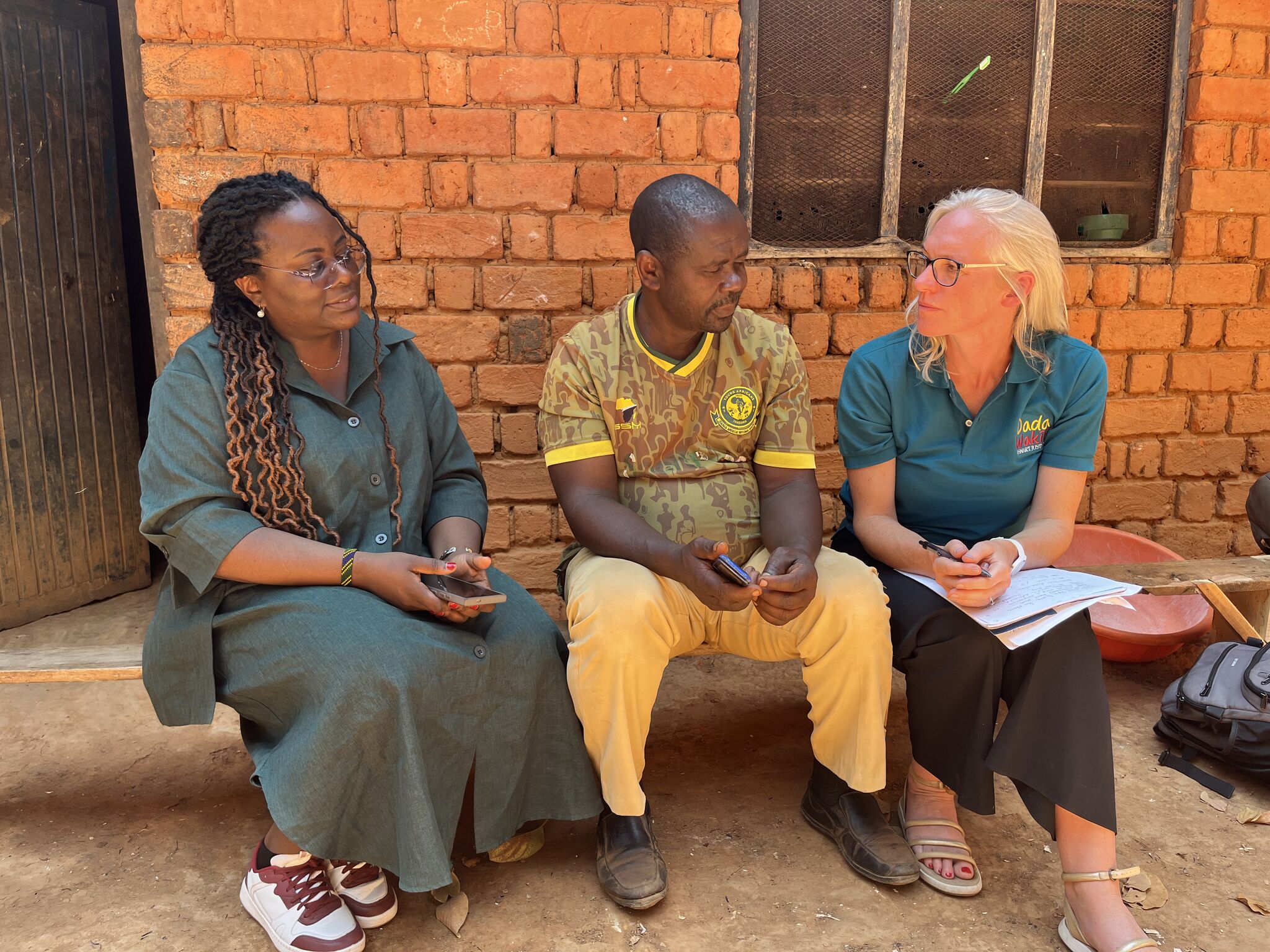
The picture is more cautious where AI is aimed directly at survivors. Tools like Tanzania’s Dada Wakili chatbot show that AI can meaningfully expand access to legal information for underserved communities. However, the brief flags real risks too: automation bias, hallucinated legal advice and the danger of retraumatisation when AI interacts with survivors without human oversight. Notably, the teams behind several of the tools examined (including Dada Wakili and BackUp, a crime-reporting platform piloted across Libya, Rwanda, Burundi, Guinea and Nigeria) deliberately stripped out generative AI features when engaging directly with survivors, relying instead on human-authored content delivered through AI-enabled channels. Neither team lacked technical capability. Automation bias, the tendency to trust a confident-sounding answer over one’s own judgment, was the concern that stopped them short, since – for a survivor asking about her rights – a wrong but confident answer can cause real harm.
What practitioners on the ground are finding
Others working in the same space echo this caution. The Oxford Institute of Technology and Justice is developing a WhatsApp-based legal chatbot for first responders in Malawi, alongside the Women Lawyers Association and Microsoft’s AI for Good Lab. The Institute sees piloting as the point. As Sara Wahedi, Technology Specialist at the Institute, put it: “[p]iloting is not a preliminary step before the real work begins. It is where the most important learning happens”.
That same team has now run co-creation sessions with more than 500 first responders and community members across Malawi and found that formal legal processes are often not survivors’ first port of call, with community structures and trusted local figures frequently carrying more weight. “We treat this as a design requirement rather than a limitation”, Wahedi said. When a first responder gives a woman accurate information about her rights, it travels with her into the informal processes she already trusts, regardless of whether a case ever reaches a formal court.
What it will take to get this right
The learning brief sets out clear recommendations for anyone designing or funding tools in this space. It says funders and designers should:
- build in multi-disciplinary expertise from the outset
- adopt formal governance and ethical frameworks
- follow established standards like the Murad Code for survivor interaction (backed by UK funding and developed in partnership with campaign group Nadia’s Initiative and the Institute for International Criminal Investigations)
It also makes the point that access to justice cannot be separated from access to support services. Deploying an AI tool without a referral pathway to medical, psychosocial or legal help is not enough. Similarly, for funders, the gap in Malawi is not primarily a technology gap, but one of connectivity, training and digitised legal texts, and no amount of model capability compensates for statutes and judgments that simply do not exist in machine-readable form.
The full Access to Justice learning brief is available to anyone working at the intersection of frontier tech and justice programming and offers a useful evidence base for funders weighing where to invest next.
Learn more
- Access to Justice: a new learning brief: A blog by Amy Nye introducing Frontier Tech Hub’s latest learning brief on integrating AI and other technologies to improve access to justice for survivors in low-resource and post-conflict settings.
- What the Oxford Institute of Technology and Justice taught us about testing tech for justice: A blog by Lil Patuck in conversation with Sara Wahedi, Technology Specialist at the Oxford Institute of Technology and Justice, reflecting on Frontier Tech Hub’s Access to Justice learning brief.
- Could designing for the “furthest first” close Tanzania’s justice gap? An interview with Felix Wood, Head of Anti-Corruption and Serious Organised Crime at the British High Commission in Tanzania, on how the team behind Dada Wakili is working with a new Frontier Tech Hub pilot to build an offline version of their AI-assisted chatbot.