
New FCDO Research Commissioning Centre funding round to understand evidence use in policymaking
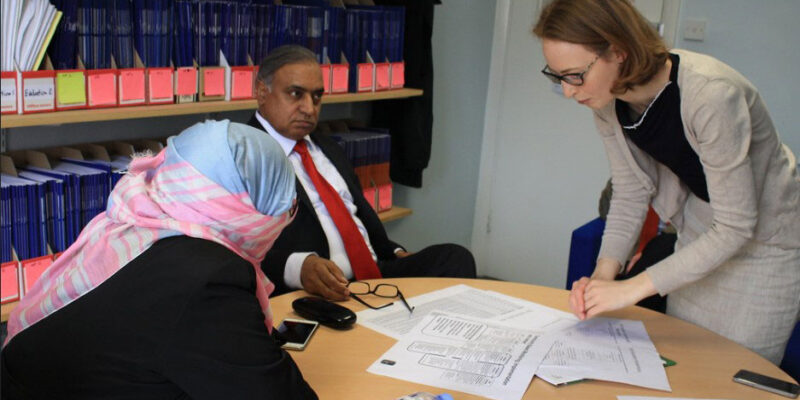
Over the past nine months, 3ie and the Economic Growth Research Team in the UK’s Foreign, Commonwealth and Development Office (FCDO) have been working together to scope a program of research on the use of evidence in policymaking. We have brought together policymakers, academics and practitioners and undertaken detailed scoping, including a systematic review with the Pan-African Collective for Evidence, to assess the state of the field and to identify key gaps for new research.
This project is one of the first to go through the FCDO’s new Research Commissioning Centre (RCC), led by 3ie and the University of Birmingham. The RCC is providing academic excellence and support to FCDO for commissioning and delivering high-quality and impactful research.
Evidence gaps
3ie and FCDO believe that policy and program decisions should be informed by the best available research evidence. Our institutions are both signatories of the Global Evidence Commitment, a statement signed by international development organizations committing them to improve their own use of rigorous evidence in decision-making (to date, FCDO, IDB, KfW, MCC, Norad, USAID and 3ie).
However, while increasing emphasis is being placed on closing the gap between research and policy and practice, the field currently lacks an evidence-informed toolbox to guide these efforts. Indeed, a number of key gaps emerged from our scoping work:
- Despite a recent rise in the number of useful frameworks, including 3ie’s own TRIPS model, the space lacks a shared conceptual framework linking evidence production, translation and use in policy and a common taxonomy of interventions.
- Previous research on the use of evidence in policymaking has engaged in only a limited way with the political, bureaucratic and institutional nature of policymaking.
- Rigorous evaluations of innovations to increase the use of evidence are limited, particularly in low- and middle-income countries.
- There is not an agreed set of indicators and outcome measures by which to assess evidence use in policymaking.
Our scoping has also suggested a number of promising approaches to advancing evidence in the field. Recent work using data from the International Growth Centre explores project design features that matter for policy impact. These include co-creation with policymakers, timing in the political term, and researcher affiliation. A series of randomized controlled trials in Brazil and in Pakistan demonstrate that robust, counterfactual evaluations of interventions designed to increase evidence use in policymaking can be successfully conducted with promising results on policy outcomes. Methodological developments in how evidence use is measured, including qualitatively coding research language in US legislative texts, offer exciting potential to capture the influence of evidence on policy in innovative ways.
We are delighted to commission a new program of research on evidence use in policymaking through the RCC, which aims to build on these developments and help fill outstanding gaps. This program will have the immediate benefit of informing how 3ie, FCDO and the RCC operationalize our goal of generating useful and impactful evidence to inform decision-making. But more broadly, we hope this research enhances collective understanding of the facilitating conditions for evidence-informed decision-making and generates actionable recommendations to support researchers, intermediaries and policymakers in the high-quality use of evidence.
Funding streams
We will soon be launching two streams of research funding in this important area. The first will focus on learning from examples of evidence use in practice in economic policymaking. Studies funded through this round would aim to produce policy case studies to shed light on the underlying factors – individual, institutional, and political – that influenced changes in the policy agenda, a government policy decision or policy change. The goal is to identify common conditions under which decision-making is informed by research evidence (or not) in government economic policymaking in Sub-Saharan Africa and South Asia and draw actionable conclusions on the factors or levers used that enabled change.
The second stream will be dedicated to evaluations of initiatives designed to increase uptake and use of evidence by policymakers. These studies may take a variety of forms, from theory-based, predominantly qualitative approaches exploring the contribution of an evidence organisation or initiative to the policy landscape to mixed-method impact evaluations of evidence use interventions.
See also
How AI can help survivors in low-resource settings access justice
Justice systems in low-resource and conflict-affected settings are often stretched to breaking point. In Malawi, for example, fewer than 800 lawyers serve a population of 22 million, and legal aid caseloads run into the tens of thousands
A major new international research and policy partnership is helping to shape the future of sustainable transport across low and middle-income countries.
Two decades of research: the Young Lives study
Young Lives is a unique longitudinal research programme that has followed 12,000 young people in Ethiopia, India, Peru and Vietnam – from infancy to adulthood – for more than 2 decades.
Lessons from the frontier of AI in international development
Artificial intelligence is often presented as a new frontier for international development. But the Frontier Tech Hub’s 4-part newsletter series, On the Frontier of AI, tells a more grounded and useful story: AI is not new, not only about large language models, and not useful unless the right data, infrastructure, institutions and safeguards are in place.