
Lessons from the frontier of AI in international development
Artificial intelligence is often presented as a new frontier for international development. But the Frontier Tech Hub’s 4-part newsletter series, On the Frontier of AI, tells a more grounded and useful story: AI is not new, not only about large language models, and not useful unless the right data, infrastructure, institutions and safeguards are in place. The series draws on nearly a decade of testing frontier technologies in low-resource settings, asking what AI has already achieved, what it has failed to address, and what choices the development sector needs to make now.
1. The hard part is rarely the algorithm
The first issue: If you’re not online, are you in the future? looks back at early AI pilots in development, including machine learning used to analyse road conditions in Zanzibar and computer vision applied to tuberculosis diagnosis among miners in South Africa. These examples underline one of the series’ core arguments: AI has been part of development practice for years, and generative AI is only one part of a much broader landscape.
The issue also highlights a recurring lesson from the Hub’s portfolio: technical performance is only part of the story. Whether AI can support better outcomes depends on the availability and quality of data, whether infrastructure can carry the tool, and whether the people most affected are visible in the systems being built. As the final issue summarises, across a decade of AI pilots in low-resource settings, “the breakthrough was rarely the algorithm” but the surrounding conditions that made the technology useful, trusted and inclusive.
2. Responsible AI decisions need to be named
The second issue: What happens when the algorithm marks its own homework? focuses on responsible AI in practice. Its central insight is that the most important ethical decisions do not always arrive labelled as ethical decisions. They can look like technical pivots, feasibility constraints, scope reductions or operational trade-offs. If those choices are not recorded, future teams cannot learn from them.
The newsletter brings this to life through examples from humanitarian supply chains, anti-corruption technology and information integrity work. In one case, a pilot exploring facial recognition for accessing food rations had to abandon the idea because of database access issues; in another, Brazil’s ALICE procurement system was designed to flag only as many cases as human auditors could realistically act on. The lesson is not simply to keep a “human in the loop”, but to design, document and preserve the reasoning behind safeguards from the start.
For development organisations, this is a practical lesson as much as an ethical one. If responsible choices are hidden in technical notes, the sector risks losing the very evidence it needs to improve. The Hub argues that teams need to build the habit of recognising when a technical call is also an ethical one, and saying so clearly, on the record.
3. The sector risks wasting AI if it does not share
The third issue: Are we about to waste it? turns to the risk of fragmentation. It starts with a powerful reminder from Ebola response: during an outbreak, time matters. The newsletter describes how EvalExplorer, an AI-enabled evidence synthesis tool, helped the FCDO Evaluation Unit identify relevant learning from past Ebola investments in two days, work that would previously have taken weeks.
But the issue’s broader argument is that individual tools are not enough. Frontier Tech Hub introduces OASIS as an open space for AI tools, code and learning for development practitioners, including EvalExplorer, a Transport Global Intelligence System in development, and DevExplorer, which supports AI-assisted analysis of IATI data.
The newsletter warns that AI could repeat mistakes seen in earlier waves of digital health innovation. In Uganda, more than 80 mHealth applications were being piloted in 2008, none reached national scale or shared data with each other, and by 2012 the government had called a halt to eHealth pilots until unified standards could be established. The Hub draws a clear conclusion: shared infrastructure and open learning matter because they allow the next person to start where the last person finished.
4. The future depends on choices made now
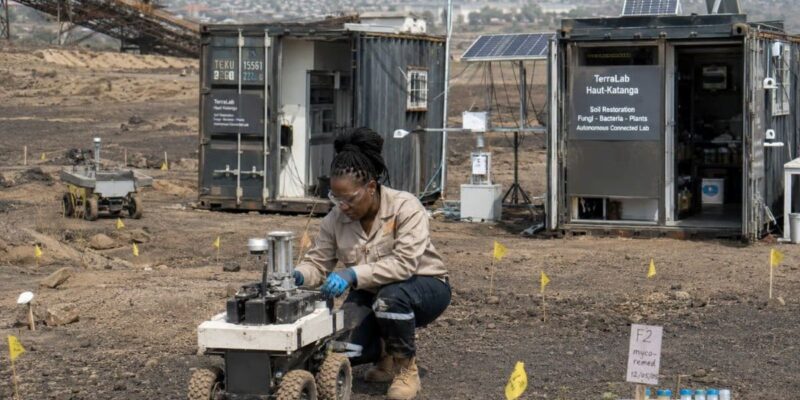
The final issue: What does international development look like in the age of AI? looks ahead. It opens with a speculative “field trip” to an AI-controlled bioremediation lab in the Democratic Republic of the Congo, then connects that imagined future to real signals emerging today. These include systems such as AlphaEvolve and Robin, which point towards AI that can propose ideas, test options and learn from results, rather than simply executing a plan designed by humans.
The issue invites readers to explore how emerging AI capabilities might change international development, then work backwards to ask what the sector needs to do now. Its conclusion brings the series together: whether AI becomes a force for empowerment or extraction depends less on the models themselves than on decisions about what to build, what to share, and who gets to decide.
What this means for development
Across the 4 newsletters, a clear message emerges. AI tools may be powerful, but they are only as useful as the systems around them. Good data, strong infrastructure, ethical decision-making, open learning and inclusive governance are not background conditions. They are the foundations for impact.
For the development sector, the opportunity is not simply to adopt AI faster. It is to adopt it better: asking who is represented, who benefits, who checks the outputs, who learns from each pilot, and who gets to shape the future.
Read the full Frontier Tech Hub AI mini-series:
• Issue 1: If you’re not online, are you in the future?
• Issue 2: What happens when the algorithm marks its own homework?
• Issue 3: Are we about to waste it?
• Issue 4: What does international development look like in the age of AI?
See more
How AI can help survivors in low-resource settings access justice
Justice systems in low-resource and conflict-affected settings are often stretched to breaking point. In Malawi, for example, fewer than 800 lawyers serve a population of 22 million, and legal aid caseloads run into the tens of thousands
A major new international research and policy partnership is helping to shape the future of sustainable transport across low and middle-income countries.
Two decades of research: the Young Lives study
Young Lives is a unique longitudinal research programme that has followed 12,000 young people in Ethiopia, India, Peru and Vietnam – from infancy to adulthood – for more than 2 decades.
Lessons from the frontier of AI in international development
Artificial intelligence is often presented as a new frontier for international development. But the Frontier Tech Hub’s 4-part newsletter series, On the Frontier of AI, tells a more grounded and useful story: AI is not new, not only about large language models, and not useful unless the right data, infrastructure, institutions and safeguards are in place.