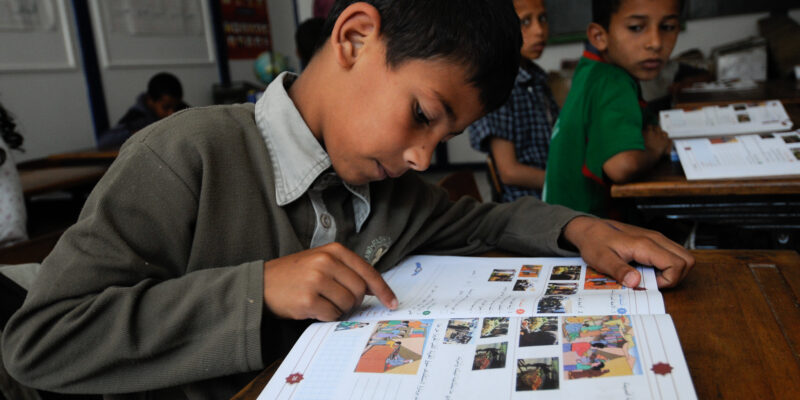
The World Bank recently unveiled the Global Education Evidence Advisory Panel (GEEAP) latest endorsed report, “Effective Reading Instructions in Low-and Middle-Income Countries: What the Evidence Shows“. This follows the regional discussions at the Association for the Development of Education in Africa (ADEA) Triennial 2025, and the British Council in Delhi. This report provides new insights and practical guidance for strengthening reading instruction in low-and middle-income countries.
The report highlights that literacy is the cornerstone of all learning. Students who develop strong reading skills are more likely to excel across subjects in school and gain access to significantly greater opportunities throughout their lives.
Drawing on around 120 studies from Africa, Asia, Latin America, and Middle East – and analysing evidence from over 170 languages – the report identifies 2 essential skills for proficient reading:
1. Decoding – recognising written letters and converting them into sounds to form words
2. Language comprehension – understanding the meaning of words, sentences and texts
To develop these abilities, children need teaching in 6 areas: oral language skills, phonological awareness, systematic phonics instruction, reading fluency, reading comprehension strategies, and writing skills. The report urges education policymakers to adopt evidence-based approaches and recommends:
- a national commitment to ensure all children become skilled readers through effective, evidence-based methods
- selecting appropriate languages for teaching and providing children with necessary support
- teaching in all 6 core skills, without expecting children to learn independently
- giving students ample time and opportunity to practise reading diverse texts
- adapting instructions for different languages while following core evidence-based principles
- supporting effective implementation through structured teacher resources and ongoing professional development
GEEAP is an independent group of leading researchers whose recommendations are grounded in rigorous evidence. The panel is co-convened by the Foreign, Commonwealth & Development Office (FCDO), the United Nations Children’s Fund (UNICEF) and the World Bank to address critical gaps in the education sector.
Baroness Chapman, Minister for International Development and Africa, said:
“Reading is a core life skill. We’re proud to support the new @GEEAP literacy report which supports governments with what works to help every child learn to read.”
Read the full report ‘Effective Reading Instruction in low – and Middle-Income Countries: What the Evidence Shows’. The GEEAP resources collection also includes the full report and executive summary.