At a time of increasing pressure on research funding globally, Young Lives stands out as a unique longitudinal research programme that has followed 12,000 young people in Ethiopia, India, Peru and Vietnam – from infancy to adulthood – for more than 2 decades. Based at the University of Oxford and collaborating with diverse in-country partners, the study is internationally recognised for research excellence, policy engagement and social impact. The most recent phase of the FCDO-funded programme, ‘Young Lives at Work’ (YLAW), closed in March 2026, after 6 years. This programme formed a core part of the GRTD portfolio, supporting two key pillars, now referred to as Growth, Energy and Infrastructure, and Technology, Gender and Inclusion.
What Young Lives sets out to do
Established by DFID in 2001, the Young Lives study is designed to generate vital insights into how poverty, inequality and global and local crises – including climate change, conflict and the COVID-19 pandemic – shape young people’s lives and to inform policies to improve their futures and advance the Sustainable Development Goals (SDGs). The YLAW phase focused specifically on the transition to adulthood, examining the links between education, skills development and employment opportunities for young people growing up in developing economies.
Real-world policy impact
Being on the ground for over two decades has enabled Young Lives to contribute to tangible policy changes and to have an impact at both the national and international levels.
One of the most significant examples is Young Lives’ direct contribution to legislative change prohibiting child marriage in Peru, which was approved into law in November 2023, protecting thousands of vulnerable girls. Its longitudinal evidence on the consequences of child marriage and early fertility – including reduced education and employment opportunities and increased risks of violence – was cited in the Parliamentary Bill. Congresswoman Flor Pablo described Young Lives research as “pivotal for driving this important legislative change… by giving voice to the lived experiences of girls and young women.” The team received the University of Oxford Social Sciences Impact Award in 2025 for this achievement. Young Lives research and policy engagement have also contributed to landmark legal reforms to reduce child marriage in India.
Other significant examples of policy impact include:
- Shifting the global debate on tackling undernutrition: demonstrating that early childhood stunting can be reversed well beyond the first 1,000 days, extending into late adolescence, with significant improvements in cognitive skills and educational outcomes
- Improving early child development through pre-school education: informing the expansion of pre-primary education in Ethiopia, with over 2.5 million children now enrolled in the ‘O-class’ early child development programme (between the ages of 4 and 7 years) —an extraordinary increase from a near-zero baseline in 2015
- Supporting vulnerable lives through social protection: informing the redesign of major social protection programmes in Ethiopia and Peru, now reaching millions of people living in food insecurity and vulnerable communities
Young Lives vision to 2030 – a lasting legacy
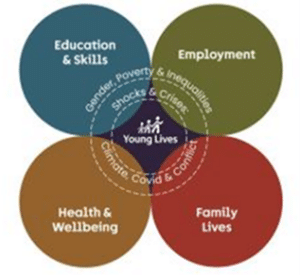 As YLAW concluded, the team produced four legacy reports covering Education and Skills, Health and Well-being, Employment, and Family Lives, bringing together key research and policy findings from two decades of Young Lives. All datasets are publicly archived and freely available through the UK Data Service, ensuring continued value for researchers and policymakers beyond the programme.
Although core GRTD funding has concluded, Young Lives has an ambitious vision to 2030, extending its mixed-methods longitudinal research to follow participants from ‘birth-to-thirty’ and generate unique evidence on the long-term and intergenerational impacts of global crises. Fundraising is on-going, with new philanthropic funding secured for the next survey round in India, and continued FCDO and Irish Aid support for further qualitative research in Ethiopia.
The team has also established the Young Lives Research Hub on Climate Change and Environmental Shocks, and secured FCDO Impact Fund support for a new SDG Life-Course Data Lab, due to launch later this year, ensuring the evidence base continues to grow.
We will publish articles and links to this work in the future, so if you are interested, do subscribe to updates from us, or follow GRTD on social media.
For further information on the programme visit the Young Lives website.